Dr.Velumani | Focus, Learn, Grow, Enjoy

Editorials

Editorials

Nueclear: Low volume – high value in-vivo diagnostics

We all claim and continue to assert that “Human is Creative”. Just because we human beings possess the skill and intelligence to communicate, listen and decipher whereas other species cannot, we identify ourselves as “Creators”. Realistically, we should not consider ourselves as “Creators” but more practically as – coordinators, managers and consumers. Look at the universe and life around us! Every element present invariably is constituted of the same three fundamental particles proton, neutron and electrons. It is the permutation and combination of these three atomic species that has given birth to the known 120 plus elements, with each bearing distinct physical and chemical properties. The fact that electrons of the elements was possible to be shared, donated or accepted, a chemical bond between elements became achievable and thereby made feasible, formation and existence of millions of molecules. These essential molecules of and for sustaining life are present in variety of forms, places and species-may it be- earth’s crust, land, water, soil, minerals, vegetables, animals and human being. If one looks at the history of evolution, mankind came much later. Just because no other species can object nor contest this claim, we humans continue to declare that we are the creators. Man indeed is intelligent! He has understood how all of these have originated, where they are, what they can do, what are his own needs, how to meet these needs, how to put things together, how to fuse technologies together and finally make things to work – to generate the products, services and solutions that keep the human being – fed, clothed, educated, entertained, empowered – enabling an enhanced quality of life and an extended lifespan. Coming back to the question again- are we really creators? With the realism that we often are shrewd, at times crude, intelligent manipulators of putting together the understood resources (which are not understood by competitors) to make solutions that are pure business or business that offers some solutions to the unmet needs or under-met demands of the human beings, I strongly desire that it is time we as human beings give up this claim. When we succeed in such large scale manipulations, it gives rise to most profitable industries, most appealing balance sheets and the most admired companies for investors. You must be wondering what has made me suddenly discuss about something which generally only philosophers talk. I sense I am beginning to understand the philosophy of diagnostic industry well. In the last 16 years of my journey in the in-vitro diagnostics, I have understood – all cost heads – starting right from the research table to the final laboratory test report in a patient hand. Compulsions, greed, opportunity for investors, vendors, distributors and laboratories, volume driven benefits to balance sheet, quality and cost, have been fairly well understood when I run today a company that charges least from the patient – in the entire world – but has the most enviable balance sheet for investors. Focus raises volumes and volumes get profitability – this is true in any field and there are hundreds of successful companies in the world. Having done it successfully well in mid volume-mid value in-vitro testing, I am tempted to venture into low volume – high value in-vivo diagnostics, with a primary focus on Nuclear Medicine. In the last 16 months (ever since this bug has bit me) I have interviewed, interacted, debated, deliberated and bargained extensively with investors, vendors and stake holders in the space “Nuclear”. I am in no way creating anything new except that I am daring and raring to put things together. Manipulation – I may also call it as – Moneypulation – where “Money” of the investors would be infused for the benefit of the “Population” at large and Cancer patients in particular. There are investors who have too much money. Vendors have enough machines and solutions. Nuclear Medicine Consultants too are eager to take off. Indian population is in need of healthcare solutions at affordable costs. I foresee a clear and affordable solution for Indian middle class for their Healthcare needs. By 2020, I also anticipate that the cost of CT, MRI and PET scans would be half of what they are presently. This clarity of the in-vivo concept made me sign in Winter 2011, a 1000 Crore deal with GE – the leaders in Molecular Imaging (a press release is given in this HS). We expect to change the way in which Nuclear Medicine or Molecular Imaging or higher end imaging is done in the country. Now, as a doctor or a hospital or a diagnostic centre –  do not look for money to buy any gadget that costs more than 2 Crores. Just visit www.nueclear.com to understand the mission and vision of “Nueclear” and partner to gallop ahead for the entire decade in diagnostics.
Editorials

Total Laboratory Automation: A journey from Rack to Track!

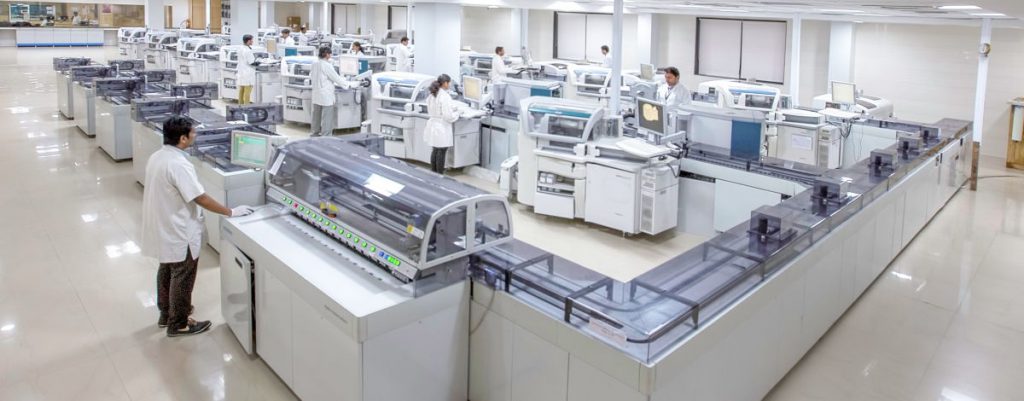
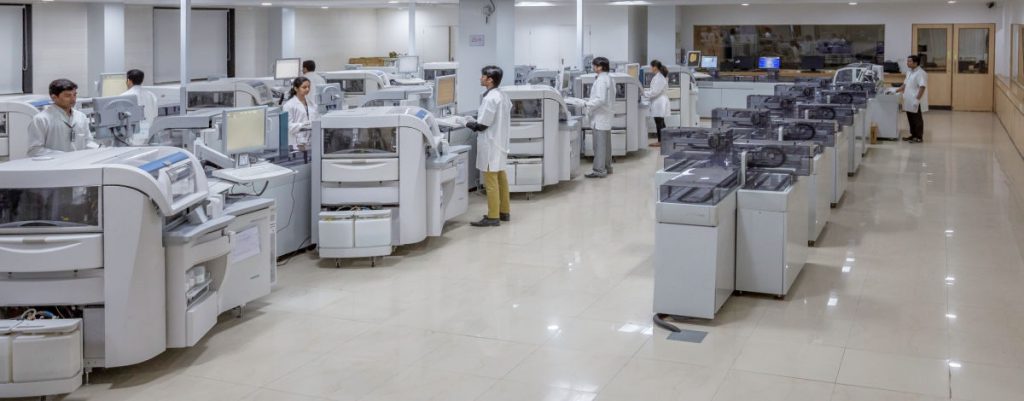
When I started Thyrocare in 1995, computers were too costly. The rate of a PC was Rs. 50,000, PC XT was Rs.75,000, PC AT was Rs. 1,00,000 and Laptop was around Rs. 2 lakhs, but my last drawn salary from BARC in the month of Aug 1994 was Rs.5846 only. So I had to buy and use a second-hand typewriter (Godrej) which did not have the letter “I” so I had to use “1” to manage it. I was one among the 50,000 laboratories in the country. Within 6 months I had enough money to buy a second-hand computer (PC XT) and thereby, I too became one among the 5000 laboratories which were called as “Computerised Pathology Laboratory”. Thereafter computers became relatively cheap and we started investing on software development. Till year 2004, our laboratory had no automations, so all work, I repeat, all 4000 specimens or 15,000 investigations per day were performed by ‘manual’ procedures using Radioimmunoassays. That time, then Bayer, now Siemens, had spotted the potentials of Thyrocare in Immunoassays business and offered their automations and reagents at a rate which could not be refused. Their automations, I accepted reluctantly because I had a worry , “how will I handle the work loads if they fail?”, though I got 3 Advia Centaurs from Bayer in the first word ‘go’. Great relief for our committed staff who no more required manual pipetting for Thyroid testing. That made us one among the 500 laboratories in the country with higher end auto-analysers and one among the 50 laboratories in the country with higher end auto-analysers for Immunoassays. Good thing about auto-analysers is that they can read barcodes and hence without wasting time, we got into conversion of our entire system to a ‘Barcoded and bi-directional interfaced’ one. As an investment, we purchased 50 lakh barcoded vials and gave 100 Barcoded Serum Vials each to 50,000 laboratories across the country free of cost. Within 30 days, we created error free, stress free comforts of barcodes in our operations; thus patient identity was assured and pre-analytical errors vanished. By that time, we had a complete “Thyrosoft” which was operating, monitoring, controlling and insisting, various procedures of laboratory operations and network operations, including enabling accounts and assisting purchase. Within another 3 years, all major global brands were interfaced using our LIS which included, Dade Behring, DPC, Abbott, Roche, Beckman Coulter, Olympus, Randox, Sysmax, Mindray thus making us a true automated laboratory – where no pipettes were used or no data entry was done manually inside the laboratory for 95% of the investigations. 200 computers in an office where 250 staff were working and “what next is possible?” was my question. Then comes another worry. Our staff have been leaving job without valid reasons and when we studied carefully, we understood that we have been asking M.Sc. qualified staff to open and close the vials and to keep and remove them from machines. Anyone who worked for 3 months – obviously realized that the task of VOVC and LMUM – means vial opening and vial closing – Loading into the Machine and Unloading from the machine is a lay man’s work and hence lost interest in it. Every worry can give rise to a new dream and thus came the dream of Lab Automation took shape. What Lab automation can do? It can centrifuge, open the vials, separate serum, it can aliquot, it can sort the samples test – wise, technology – wise, analyser – wise, it can take the sample to the machine on a track, get it tested by that analyser, move it further on the track for processing by another analyser and finally after all tests are done, it can close the vial and dispatch it to a specific position in a specific rack in cold room. A 30 meter long track can hook 30 analysers (Immunoassays, Photometry, Haematology, Coagulation) and could help laboratory staff to do scientific work instead of mundane, non-motivating VOVC work. The major vendor for us has been Siemens and fortunately they are leaders in automation in almost every industry. A lot of mutual studies for more than 1 year, a lot of negotiations, a couple of visits to their locations and sites, finally ended up in a Rs. 100 crore deal on 28.1.2011. First time in the history of Thyrocare or Siemens Diagnostics or Indian Diagnostic industry – a deal of this size has been signed where, Siemens will provide adequate tracks of length that our analysers need, automatic vial openers, sorters, vials closers, centrifuges, storage systems, softwares, supply analysers, keep them up and supply reagents for another 7 years to come. It was another proud movement for me since our team had arranged for “Live web telecast” for our family of 2500 family (network) members across the country, 500 Siemens family members of Siemens (Indian and Global) and made them to listen to Shri. D Raghavan, CEO, Siemens Healthcare “This is the first Lab Automation in India and the longest in the World”. I wish to congratulate every Thyrocarean for this unique feat and feeling which again makes Thyrocare ‘different’ from the rest. Another happy news for Thyrocareans; so far we had been working in a 50,000 sq feet laboratory and now we have purchased another building of 1,60,000 sq feet in an adjacent plot. Thus, we have a capability in terms of space and automation to process 2 lakh specimens a day and generate Rs.1000 crore per annum turnover. Year is young, decade is too young so let us resolve to use this space wisely and bring in prosperity for all those who hold “Brand Thyrocare” and add more value to all those who use “Brand Thyrocare”. Cheers!!!

Editorials

Musings and Aspirations

If you were to utter the word automation, most people would conjure up images of nothing but fancy ultramodern sophisticated gadgets or instruments. But to me, the word brings on nostalgic thoughts of a gentleman from Bhabha Atomic Research Center (BARC). During the 1980’s I had the good opportunity to work with the late Mr. M.N. Mehta, a scientific officer in BARC from whom I first learnt about Radioimmunoassays. He was predictability personified. Every thing he did, he did, as though he were an automated robot. Starting from his daily arrival to the lab, the removing of reagents from the refrigerator, switching on the centrifuge, every single activity was timed with utmost precision. If a batch of tubes had to be incubated for 90 minutes he would do it in precisely 90 minutes, 99% of the times and probably vary by plus minus 5 minutes in the remaining 1%. Since everything was so predictable neither the patients had to wait for the reports, nor colleagues no family members had anything to complain about. A person who would cheerfully do the same job, same way, same time, every day, day after day was a matter of wonder for me. His simplicity really awed me. As computers were still very scarce those days, according to me he was the best possible ‘versatile RIA automated system’ available then. In 1984, the first computer, a huge one that occupied half the space in a 10ft × 10ft room was installed in out department at BARC. The late Dr. R. D. Ganatra, the then Head, Radiation Medicine Centre, had decreed that only those involved with its immediate use were to be allowed to go anywhere near it. All others including many senior officers were simply left wondering what it looked like and what great functions and tasks could it perform. Being merely a scientific assistant, entry to that room itself was forbidden for me. But soon, my curiosity got the better of me; one evening after most of the staff had left, with the help of a friendly security officer I managed to sneak in. Just as we were about to switch it on, out of nowhere appeared, Dr. Ganatra putting us in a terrible quandary. We were threatened with a possible memo, on the grounds of stealing sensitive BARC data! Only after a lot of cajoling and apologies were we finally let off. Today, in my organization, which happens to be the world’s largest thyroid testing laboratory, almost every one has a PC. Our computers are networked around very powerful softwares that allow employees to do on those computers what the Company wants them to do and NOT what they want to. The PC’s are all equipped for the following: Barcoded data entry Franchisee bills Vendor bills Patient data and reports No manual entries are permitted inside the ‘online’ laboratory. No specimen is accepted that is not received in a barcoded vial, no cheque or DD is accepted without a barcode behind the instrument, no bills or communications are accepted without a barcode on it. No file or no library book in the organization is without a barcode. If a franchisee is overdue on payment he cannot access his reports. If a staff member has not completed his work, he cannot log out. Every director gets information on his monitor, what time, which consignment is received, what time, which sample and for what it is cancelled, what subject and from whom a letter is sent out or received, who entertained which visitor, which client from which part of the country sends for particular tests more than the rest, 100 such informative mails goes to relevant directors each day. The best part is that even if some one wants to make an error, they have to plan for it meticulously. No doubt that computers today are an indispensable part of any business or for life itself. But I still hold for Mr. Mehta in high esteem and fondly remember him even in this computer age.

Scroll to Top